
Cashback Bonus Overview in Ind Rummy
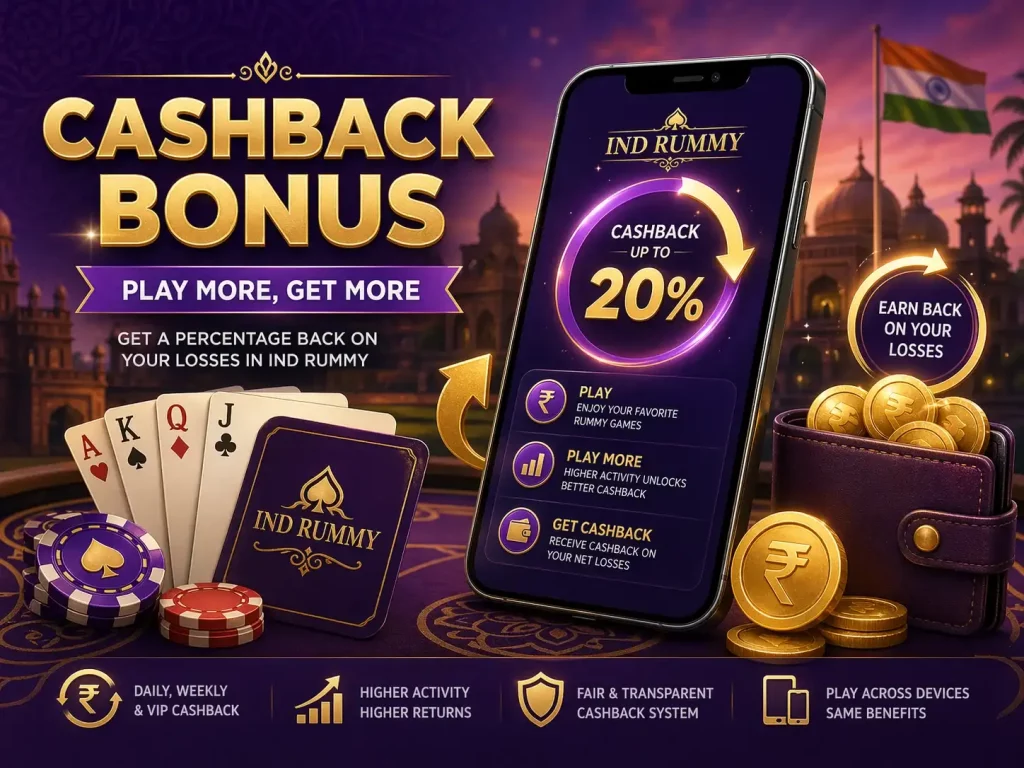
Cashback bonus is a structured return system that focuses on long-term activity rather than isolated outcomes. In Ind Rummy, this mechanism evaluates gameplay over a defined period and returns a percentage of losses based on overall engagement. Instead of reacting to single sessions, the system continuously tracks activity and builds toward a calculated return.
This approach creates a more stable framework where results are not limited to wins or losses in one moment. Every action contributes to a broader calculation, which allows value to accumulate even during less favorable outcomes. The system operates in the background, collecting data and applying returns at specific intervals.
How Cashback Is Calculated
The calculation of cashback is primarily based on net loss. This represents the difference between total bets placed and total winnings received. A percentage of this amount is returned after the evaluation period ends.
Because of this structure, cashback reflects actual performance rather than isolated actions. It ensures that returns remain proportional and balanced, without overcompensating or distorting the gameplay cycle.
At the same time, total betting volume plays a key role. Higher activity leads to more accurate calculations and more noticeable cashback values. This is especially relevant in fast-paced environments where multiple rounds are played in a short period.
For example, when players engage in Slots, the number of bets increases rapidly, which accelerates the accumulation of cashback. The more activity recorded, the more consistent the return becomes over time.
Cashback Structure and Types
Cashback in Ind Rummy is typically divided into several categories based on timeframes and activity levels. These categories operate independently, allowing multiple return streams to function simultaneously.
| Cashback Type | Percentage | Calculation Period | Basis |
|---|---|---|---|
| Daily Cashback | Up to 5% | 24 Hours | Total Bets |
| Weekly Cashback | Up to 10% | 7 Days | Net Loss |
| VIP Cashback | Up to 20% | Flexible | Activity Level |
Daily cashback focuses on short-term activity, returning a small percentage based on a 24-hour cycle. Weekly cashback expands this by analyzing performance over a longer period, which allows for higher return percentages.
VIP cashback operates differently. It is not limited to fixed intervals and instead adjusts based on long-term engagement. This makes it more dynamic and closely tied to consistent activity.
Activity Levels and Cashback Growth
As activity increases, cashback percentages typically grow. This creates a direct relationship between participation and return value.
This progression ensures that the system remains balanced while still rewarding consistent engagement. Lower levels provide steady returns, while higher tiers unlock increased percentages over time.
The gradual increase allows players to understand how their activity translates into measurable value. It also ensures that the system remains predictable and transparent.
Balance Distribution and Cashback Impact
Cashback affects how funds are distributed within a player’s balance. Instead of a simple decline, the system introduces periodic recovery, which changes the overall structure of gameplay.
The circular distribution shows how cashback contributes to overall balance recovery. Even partial returns can influence long-term results, especially when combined with consistent activity.
This creates a cyclical pattern where a portion of losses is periodically restored. Instead of relying solely on outcomes, the system introduces an additional layer that works independently.
Cashback vs Standard Gameplay Flow
The difference between gameplay with and without cashback becomes more noticeable over extended sessions. The system modifies how balance changes over time.
| Factor | Without Cashback | With Cashback |
|---|---|---|
| Balance Movement | Linear Decline | Cyclical Recovery |
| Session Length | Shorter | Extended |
| Volatility Impact | High | Moderate |
Without cashback, balance tends to follow a direct decline based on outcomes. With cashback, part of the loss is returned, which changes the overall flow and introduces recovery points.
System Integration
Cashback in Ind Rummy works as part of a broader reward structure. It does not replace other systems but complements them. For example, it can function alongside a standard bonus, creating multiple layers of value.
In most cases, cashback is applied automatically. After completing the required period, the system processes the data and returns the calculated amount. Sometimes a simple login is required to confirm the credit, but the process remains straightforward.
This integration ensures that cashback remains a natural part of the overall experience. It does not interrupt gameplay or require additional steps beyond normal activity.
Cashback Rates and Player Activity Levels
Cashback bonus in Ind Rummy is directly influenced by player activity levels. The system does not treat all users одинаково — instead, it adjusts return percentages depending on how consistently and how actively a player participates over time.
This creates a tier-based structure where each level reflects a different stage of engagement. The more stable and frequent the gameplay, the higher the cashback percentage becomes. This progression is gradual and based on measurable factors such as total bets, session frequency, and duration of activity.
Unlike fixed rewards, cashback adapts dynamically. It evolves alongside player behavior, which means that long-term participation becomes more valuable than short bursts of activity. This approach ensures that returns remain balanced while still rewarding consistency.
Activity-Based Cashback Growth
At lower levels, cashback percentages remain relatively modest. This allows the system to introduce returns in a controlled way without creating imbalance. As activity increases, the percentage grows, reflecting a higher level of engagement.
| Level | Activity Range | Cashback Rate | Access Type |
|---|---|---|---|
| Basic | Low Volume | Up to 5% | Standard |
| Regular | Moderate Activity | Up to 8% | Extended |
| Advanced | High Volume | Up to 12% | Priority |
| VIP | Very High Activity | Up to 20% | Exclusive |
This table illustrates how cashback evolves alongside player progression. Each level unlocks a higher return rate, which reinforces the connection between activity and reward.
Visualizing Cashback Progression
To better understand how cashback percentages increase with activity, it is useful to look at a visual representation of this growth.
The chart clearly shows a steady increase in cashback percentages across different activity levels. This progression is not random but follows a structured pattern based on participation.
Consistency vs Short-Term Activity
One of the most important aspects of cashback is that it rewards consistency rather than short-term spikes. A player who engages regularly over multiple sessions will typically receive better returns compared to someone who plays intensively for a short period and then stops.
This system encourages stable interaction patterns. Instead of focusing on individual outcomes, cashback evaluates long-term behavior and adjusts returns accordingly.
Because of this, the system becomes more predictable. Players can estimate potential cashback based on their activity level and adjust their approach if needed. This transparency makes the system easier to understand and more reliable over time.
Integration with Overall Reward Structure
Cashback does not exist in isolation. It works alongside other reward mechanisms, creating a layered system where different types of returns serve different purposes.
For example, while a bonus may increase available balance, cashback focuses on recovering part of the spent amount. Together, these systems create a more complete structure where both expansion and recovery are supported.
Over time, this integration forms a continuous cycle. Activity generates volume, volume contributes to cashback, and cashback feeds back into the balance. This loop allows the system to function as a core part of the overall experience rather than a separate feature.
How Cashback Affects Balance Recovery in Ind Rummy
Cashback bonus becomes even more important when viewed from the perspective of balance recovery. In Ind Rummy, it is not simply a return feature attached to activity. It also changes how players experience the overall flow of losses, returns, and remaining funds across longer periods of play.
Without cashback, balance movement is more direct. Funds decrease according to outcomes, and there is no built-in layer designed to soften that decline. With cashback included, the structure becomes more flexible because a portion of net loss returns to the account after the evaluation period ends. This does not remove risk or alter outcomes, but it does reshape the financial rhythm of gameplay.
This difference is especially noticeable over multiple sessions. A single session may not fully show the value of cashback, but over several rounds of activity, the return system starts to create a more visible recovery cycle. Instead of seeing only deductions from the balance, players begin to see a pattern where part of the spent amount is restored.
That restored value can influence how future sessions are approached. Since cashback is based on tracked activity, it adds a measurable element to the overall structure. The player is no longer relying only on direct game results. There is also a separate return layer working in parallel with the normal balance flow.
Cashback and Balance Structure
The impact of cashback can be understood more clearly when comparing standard balance movement with a system that includes periodic returns. In a standard model, balance tends to follow a simple decline-and-replenish pattern based only on deposits, wins, and losses. In a cashback model, the pattern becomes more cyclical because a portion of losses is returned after a defined interval.
This creates a different type of financial pacing. It does not mean that losses disappear, but it does mean that the system recognizes activity over time and returns a percentage accordingly. That percentage may seem moderate on paper, yet its cumulative effect can be significant when viewed over a longer cycle.
| Factor | Without Cashback | With Cashback |
|---|---|---|
| Balance Movement | Direct decline based only on results | Partial recovery after each evaluation cycle |
| Loss Recovery | Depends entirely on future wins | Includes a percentage return from tracked losses |
| Session Continuity | Balance pressure builds faster | Returned value supports longer continuity |
| Value Cycle | Outcome-driven only | Outcome plus structured return mechanism |
The comparison above shows that cashback introduces a second layer into the balance model. The first layer is still the normal gameplay result. The second layer is the return percentage applied to tracked activity. When both are combined, the overall structure becomes less linear and more adaptive over time.
Circular View of Cashback Distribution
A circular chart is one of the clearest ways to show how cashback fits into the balance picture. Instead of looking at activity only as deposits and losses, the chart introduces an additional segment that represents recovered value.
This is important because cashback should not be treated as a vague promotional extra. It is a definable portion of the overall balance distribution. Once that portion is visualized, it becomes easier to understand how the return mechanism affects the total picture.
The chart highlights that cashback is not meant to dominate the balance. Instead, it acts as a partial recovery mechanism. That is exactly what makes it practical. It introduces a measurable return without pretending to replace the entire loss structure.
In a long-term context, even a moderate recovered share can become meaningful. Over repeated cycles, small percentages accumulate into a clearer financial effect. That accumulation is where cashback becomes most valuable.
Why Recovery Cycles Matter
Recovery cycles matter because most players do not engage with a platform in one isolated session. Their activity often spreads across multiple days or weeks. When a system tracks activity over time, the result is more than a single number. It becomes a pattern.
Cashback works within that pattern by creating recurring return points. These return points break the sense of uninterrupted decline and replace it with a more dynamic cycle. Instead of only spending and waiting for positive results, the player also sees periodic compensation based on recorded activity.
This does not transform cashback into a guaranteed gain. It remains a return on part of net loss, not an independent source of profit. However, it does affect how balance develops over time, and that makes it strategically relevant within the broader reward structure.
Another reason recovery cycles matter is predictability. A player may not know the exact result of a future session, but they can understand how cashback will be calculated if a defined loss threshold is reached. This makes the system easier to follow and more transparent than purely event-based promotional features.
Cashback as a Layered Return Mechanism
One of the strengths of cashback is that it operates separately from direct game outcomes. A win affects balance immediately. Cashback affects balance later, after activity is reviewed. This difference in timing creates a layered effect.
The first layer is immediate and result-based. The second is delayed and calculation-based. Together, these layers form a broader structure in which value enters the account through more than one route. This is part of what makes cashback feel more integrated into the overall system rather than simply attached to it.
In Ind Rummy, this layered structure also supports consistency. If all value depended only on immediate results, the system would feel more volatile. Cashback reduces that volatility by introducing a controlled return interval that is linked to recorded data rather than chance alone.
Long-Term Relevance of Cashback
The long-term relevance of cashback comes from repetition. A single return may appear modest, but repeated returns across multiple cycles change the wider picture. The system becomes more meaningful as activity continues because the total recovered amount keeps building from one evaluation period to the next.
This is why cashback is best understood as a structural feature rather than a short-term offer. It performs its function over time, responding to patterns of play and returning part of the tracked loss according to clear rules. The longer the cycle of engagement, the easier it becomes to see the cumulative effect.
For players reviewing the overall reward environment in Ind Rummy, cashback stands out because it converts activity data into measurable recovery. It does not rely on surprise elements. It works through a visible formula, which makes it easier to understand and easier to incorporate into the broader balance framework.
The Role of Cashback in Ongoing Play
Ongoing play is shaped not only by results but also by how the system responds to recorded activity. Cashback plays a role here by ensuring that losses are not viewed only as final deductions. Instead, they become part of a tracked cycle that may generate a return at the end of the period.
This makes the financial structure more layered and more analytical. Rather than focusing only on what is lost in the moment, cashback introduces the idea of what portion may come back later. That shift changes how balance recovery is understood inside the platform.
Overall, cashback bonus in Ind Rummy supports a more structured recovery model. It adds a measurable return layer, improves visibility around balance distribution, and creates recurring value through tracked activity. Across repeated sessions and longer cycles, this mechanism becomes one of the clearest ways to connect volume, loss tracking, and financial recovery into one system.
Cashback Integration Across Platforms and Final Insights
Cashback bonus in Ind Rummy is not limited to a single environment. It is designed to function consistently across different platforms, ensuring that all recorded activity contributes to the same calculation regardless of where it takes place. This unified structure allows players to move between devices without affecting how cashback is tracked or applied.
The system operates on shared data. Whether activity occurs on desktop or through the app, the same metrics are collected and processed within a single framework. This ensures that there are no gaps in tracking and no fragmentation in how cashback is calculated.
From a structural perspective, this consistency is essential. Cashback relies on cumulative data, and any separation between platforms would reduce its accuracy. By maintaining a unified system, Ind Rummy ensures that all activity is accounted for in the same way.
Cross-Platform Cashback Performance
Different platforms offer slightly different interaction speeds and accessibility, but the cashback logic remains unchanged. The only difference lies in how quickly players can access and monitor their activity.
| Platform | Tracking Speed | Access | Cashback Logic |
|---|---|---|---|
| Desktop | Standard | Full Interface | Identical Calculation |
| Mobile | Faster Interaction | Quick Access | Identical Calculation |
This comparison highlights that cashback behavior does not change depending on the device. The same percentages, rules, and evaluation methods apply across all platforms.
Cashback Distribution in a Multi-Platform Environment
To understand how cashback integrates into overall activity across devices, it is useful to visualize how different segments contribute to the total calculation.
The chart demonstrates how different activity sources contribute to the total structure while cashback remains a defined portion of the overall distribution.
Final Perspective on Cashback Systems
Cashback in Ind Rummy functions as a long-term structural element rather than a temporary feature. It connects player activity, recorded volume, and calculated returns into a continuous system that operates independently from immediate outcomes.
Across all parts of the system, cashback remains consistent. It is calculated using the same logic, applied at defined intervals, and based on measurable data. This consistency makes it one of the most transparent reward mechanisms within the platform.
Another important point is that cashback does not replace other reward types. It exists alongside them, adding a recovery layer that complements standard structures. While other systems may focus on increasing available balance, cashback focuses on returning part of what has already been spent.
Over extended periods, this creates a more complete framework where different forms of value interact. Activity generates data, data leads to calculation, and calculation produces a return. This cycle continues across sessions, building a pattern that reflects long-term engagement.
From a broader perspective, cashback provides a way to interpret activity beyond individual outcomes. It introduces a measurable return that is not tied to a single event but to the entire sequence of participation. This makes it easier to evaluate how gameplay translates into value over time.
In Ind Rummy, the cashback system is fully integrated into the overall structure. It works across platforms, adapts to activity levels, and contributes to balance recovery through clearly defined calculations. As a result, it stands as one of the most stable and predictable components within the reward system.






Comments