

Bonus Funds System in Ind Rummy
Bonus funds represent a structured layer within the overall balance system in Ind Rummy. Unlike regular funds, they are issued under specific conditions and are designed to be used within defined gameplay parameters. These funds are not immediately withdrawable but instead follow a conversion process based on activity.
The main purpose of bonus funds is to extend gameplay potential by providing additional value that can be used alongside real balance. Instead of relying solely on deposited funds, players gain access to an extended balance pool that operates under a separate logic.
In Ind Rummy, bonus funds are usually tied to actions such as sign up or other predefined triggers. Once credited, they become part of the available balance but are clearly separated in terms of usage rules and withdrawal conditions.
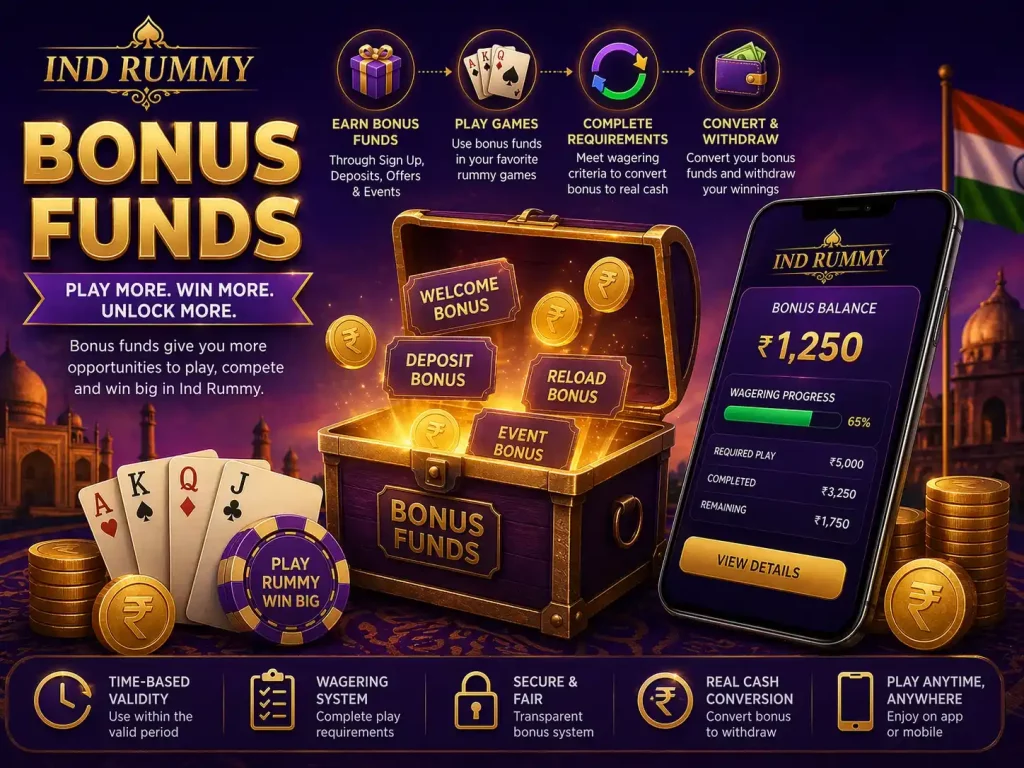
This distinction is important because bonus funds behave differently from cash balance. While real funds can be withdrawn directly (subject to platform rules), bonus funds must first meet specific requirements. These requirements typically involve gameplay activity, which converts bonus value into withdrawable funds over time.
Another key characteristic is that bonus funds are not static. Their value changes depending on how they are used. As gameplay progresses, part of the bonus may be converted, while another part remains locked until further conditions are met.
Types of Bonus Funds
Different types of bonus funds exist within Ind Rummy, each with its own logic and structure. These variations allow the system to support different entry points and activity levels.
| Bonus Type | Trigger | Usage | Conversion Method |
|---|---|---|---|
| Welcome Bonus | Account Creation | Initial Gameplay | Wager-Based |
| Deposit Bonus | First Deposit | Extended Play | Percentage Unlock |
| Reload Bonus | Repeat Deposit | Continued Activity | Tier-Based |
| Event Bonus | Special Conditions | Limited-Time Play | Fixed Unlock |
Each of these types introduces a different interaction model. Some are designed for new users, while others are structured for ongoing participation. Despite these differences, all bonus funds follow the same fundamental principle: they must be converted through gameplay.
Bonus Funds Conversion Flow
The conversion process is central to understanding how bonus funds operate. Instead of being immediately available for withdrawal, bonus funds move through a structured pipeline where activity determines how much becomes real balance.
The chart shows how bonus funds move through different stages. Not all issued funds become withdrawable immediately. A portion is used in gameplay, a part is converted, and the remaining amount stays locked until further conditions are met.
Interaction Between Bonus Funds and Gameplay
Bonus funds are closely tied to gameplay mechanics. They are not passive values but active elements that require participation. The more structured the gameplay, the more predictable the conversion becomes.
In Ind Rummy, different games contribute differently to bonus conversion. Some formats may count fully toward wagering requirements, while others may contribute partially. This creates a weighted system where not all activity is treated equally.
For example, specific games may have a higher contribution rate, allowing faster conversion. Others may have reduced impact, requiring more activity to achieve the same result.
Because of this, bonus funds introduce an additional layer of strategy. Instead of focusing only on outcomes, players also interact with how different formats influence the conversion process.
Bonus Funds as a Separate Balance Layer
Bonus funds are always tracked separately from real balance. This separation ensures clarity in how funds are used and converted. Players can see exactly how much of their balance comes from bonus sources and how much is withdrawable.
This separation also ensures that the system remains transparent. Since bonus funds follow different rules, keeping them distinct prevents confusion and allows for more accurate tracking of activity.
In Ind Rummy, bonus funds are integrated into the overall balance system without replacing it. They function alongside real funds, creating a layered structure where different types of value coexist.
Summary of Bonus Funds Logic
Bonus funds in Ind Rummy operate through a structured system based on issuance, usage, and conversion. They are tied to specific triggers, require gameplay activity, and follow defined rules before becoming withdrawable.
The system is built around measurable data, ensuring that every stage of the process can be tracked and understood. From initial allocation to final conversion, bonus funds move through a clear and predictable cycle.
Bonus Funds Usage and Wagering Mechanics in Ind Rummy
Bonus funds in Ind Rummy are not only defined by how they are issued, but also by how they are used during gameplay. Once credited, these funds become part of a controlled system where each action contributes toward a defined wagering requirement. This requirement determines how and when bonus funds can be converted into withdrawable balance.
The wagering mechanism acts as a bridge between issued bonus value and real funds. Without completing this process, bonus funds remain locked within the system. This ensures that all conversions are tied to measurable gameplay activity rather than instant availability.
Unlike static balance systems, wagering introduces progression. Each action contributes to an overall requirement, and this progress is tracked continuously. The system does not reset randomly, and all contributions accumulate until the condition is fulfilled.
Understanding Wagering Contribution
Not all gameplay contributes equally to wagering. In Ind Rummy, different formats and modes may have varied contribution rates. Some may count fully toward the requirement, while others may contribute partially. This creates a weighted structure that reflects gameplay diversity.
For example, standard card-based gameplay typically contributes at a consistent rate. Other formats, depending on their structure, may have adjusted contribution values. This ensures that the system remains balanced and does not favor a single activity type disproportionately.
The key idea is that bonus funds are activated through participation. The more structured and consistent the gameplay, the more predictable the conversion becomes.
Wagering Requirement Structure
| Bonus Amount | Wager Multiplier | Total Required Play | Contribution Type |
|---|---|---|---|
| ₹100 | 10x | ₹1000 | Full Contribution |
| ₹500 | 8x | ₹4000 | Mixed Contribution |
| ₹1000 | 6x | ₹6000 | Weighted Contribution |
| ₹5000 | 5x | ₹25000 | Tier-Based Contribution |
This table demonstrates how wagering scales with bonus size. Larger bonuses often come with lower multipliers but require higher total activity due to their size. The system balances accessibility with proportional requirements.
Bonus Conversion Distribution
To better understand how wagering affects bonus funds, it is useful to look at how different portions of the bonus are distributed during the conversion process.
The diagram shows how bonus funds are divided during usage. A portion is actively used in gameplay, another part becomes converted, and the remaining balance stays locked until further activity is completed.
Interaction Between Bonus Funds and Games
Bonus funds are tightly connected to gameplay environments. Different games contribute differently to the wagering process, and this variation influences how quickly funds can be converted.
Certain games may allow full contribution, meaning every unit wagered counts toward the requirement. Others may apply a reduced percentage, requiring more total activity to achieve the same progress.
This structure ensures diversity within the system. It prevents a single format from dominating the conversion process and encourages a broader interaction across different games.
The presence of multiple contribution types creates a layered interaction model. Instead of a single linear path, bonus funds move through different stages depending on how they are used.
Tracking Progress and Conversion
One of the key elements of bonus funds is progress tracking. Players can monitor how much of the wagering requirement has been completed and how much remains. This visibility ensures that the system remains transparent and measurable.
The progress is typically shown as a percentage or a value relative to the total requirement. As gameplay continues, this value increases until it reaches the threshold needed for conversion.
Because the system is cumulative, partial progress is never lost. Every action contributes toward the final goal, making the process consistent and predictable over time.
Bonus Funds in APK and Mobile Environments
In Ind Rummy, bonus funds behave consistently across different access methods, including mobile environments such as apk-based access. The calculation, wagering requirements, and conversion logic remain identical regardless of the device used.
The only difference lies in accessibility and interaction speed. Mobile environments allow faster access to gameplay, which can influence how quickly wagering requirements are completed.
This ensures that bonus funds remain fully integrated into the system without fragmentation between platforms.
Summary of Wagering Mechanics
Bonus funds in Ind Rummy are governed by a structured wagering system that connects gameplay activity with conversion. Each unit of activity contributes toward a defined requirement, and progress is tracked continuously until completion.
The system balances accessibility with control by adjusting contribution rates and multipliers based on bonus type and activity level. Through this structure, bonus funds transition from locked value into real balance in a predictable and measurable way.
Bonus Funds Expiry, Limits, and Time-Based Conditions in Ind Rummy
Bonus funds in Ind Rummy are not only defined by how they are issued and converted, but also by how long they remain active. Every bonus allocation is tied to a time-based structure that determines its availability window. If the conditions are not met within this period, the remaining bonus funds may expire or become inactive.
This time-based element adds another layer to the system. It ensures that bonus funds are used within a defined cycle and prevents indefinite accumulation without activity. As a result, players must consider not only how to convert bonus funds, but also when to use them.
Unlike wagering requirements, which focus on total activity, expiry conditions focus on duration. These two mechanisms work together to create a balanced system where both volume and timing are important.
Bonus Expiry Structure
Each type of bonus fund typically has a different validity period. Some are short-term and designed for immediate use, while others allow extended periods for conversion.
| Bonus Type | Validity Period | Expiry Condition | Remaining Value |
|---|---|---|---|
| Welcome Bonus | 7 Days | Unconverted Funds Expire | Removed |
| Deposit Bonus | 14 Days | Partial Expiry | Remaining Locked |
| Reload Bonus | 30 Days | Time-Based Reduction | Reduced |
| Event Bonus | Limited | Fixed Deadline | Fully Removed |
This table highlights how expiry varies depending on bonus type. Short-term bonuses encourage immediate use, while long-term bonuses allow extended conversion cycles.
Time-Based Bonus Reduction
To better understand how bonus funds change over time, it is useful to visualize how value decreases if conditions are not met within the allowed period.
This chart shows how bonus value may decline over time if not converted. The reduction is not always linear, but it illustrates the general idea that unused bonus funds lose value as the expiry date approaches.
Limits and Maximum Conversion
Bonus funds are also subject to limits. These limits ensure that the system remains balanced and that conversions stay within defined boundaries. Limits may apply to maximum withdrawable amounts, conversion rates, or usage per session.
For example, a bonus may allow full conversion only up to a certain amount. Any excess value may remain locked or be partially converted depending on the rules. This ensures that bonus funds maintain their intended structure without exceeding predefined thresholds.
Limits also apply to how bonus funds interact with gameplay. Some formats may restrict the amount of bonus funds that can be used per session, ensuring that the system remains consistent across different activity levels.
Time vs Activity Balance
One of the most important aspects of bonus funds is the balance between time and activity. Wagering requirements focus on how much is played, while expiry conditions focus on when it is played.
These two elements must align for successful conversion. High activity within a short time frame may lead to faster conversion, while slower activity may require careful time management to avoid expiry.
This balance creates a structured system where both factors contribute equally. Players must consider not only how much they play, but also how efficiently they use the available time.
Bonus Funds and Platform Behavior
Bonus funds behave consistently across all platforms in Ind Rummy. Whether accessed through desktop or mobile, the expiry logic and limits remain unchanged.
However, faster interaction environments may influence how quickly bonus conditions are met. Platforms that allow quicker access to gameplay can indirectly affect how efficiently bonus funds are used within the available timeframe.
This ensures that the system remains unified while still adapting to different usage patterns.
Long-Term Role of Expiry Mechanics
Expiry mechanics are essential for maintaining system balance. Without them, bonus funds could accumulate indefinitely, reducing the need for structured gameplay.
By introducing time limits, the system ensures that bonus funds remain part of an active cycle. They are issued, used, and either converted or expired within a defined period. This cycle keeps the system dynamic and measurable.
At the same time, expiry does not remove value arbitrarily. It operates under clear rules, allowing players to understand exactly how long they have to complete the required conditions.
Summary of Time-Based Bonus Logic
Bonus funds in Ind Rummy are governed not only by wagering but also by time-based conditions. Expiry periods, limits, and reduction mechanisms all contribute to a structured system where both activity and timing determine the final outcome.
By combining these elements, the system creates a controlled environment where bonus funds follow a predictable lifecycle. From allocation to conversion or expiry, each stage is defined by measurable rules that ensure consistency across the platform.
Bonus Funds Tracking, Withdrawal Conditions, and Final Overview in Ind Rummy
Bonus funds in Ind Rummy reach their final stage when they transition from a locked state into withdrawable balance. This stage is the result of completed wagering requirements, valid usage within the time window, and adherence to all system limits. Once these conditions are satisfied, the converted portion becomes part of the real balance and follows standard withdrawal rules.
This final step is not immediate but structured. The system evaluates all activity before releasing funds, ensuring that only the eligible portion is converted. Any remaining locked bonus value that does not meet the conditions stays within the system until either converted or expired.
The separation between bonus funds and real balance remains critical even at this stage. Only the converted portion is considered eligible for withdrawal, while unconverted funds continue to follow the original rules.
Withdrawal Eligibility Structure
| Stage | Bonus Status | Withdrawable | Condition |
|---|---|---|---|
| Issued | Fully Locked | No | Awaiting Gameplay |
| In Progress | Partially Used | No | Wagering Ongoing |
| Converted | Unlocked Portion | Yes | Requirements Met |
| Expired | Removed | No | Time Limit Reached |
This table outlines the lifecycle of bonus funds from issuance to final outcome. Each stage is clearly defined, and the transition between them depends on activity and timing.
Bonus Conversion Progress Visualization
To understand how bonus funds move toward withdrawal eligibility, it is useful to visualize the progression from locked value to converted balance.
The chart illustrates how bonus funds are distributed across different stages. Only a portion becomes fully converted, while other parts remain locked or may expire depending on conditions.
Tracking Bonus Progress
Tracking plays a crucial role in the final stage of bonus funds. Players can monitor how much of the wagering requirement has been completed and how close they are to conversion.
This tracking is usually presented as a percentage or a value relative to the total requirement. As gameplay continues, progress increases until the required threshold is reached. Once completed, the eligible portion is unlocked automatically.
The transparency of this process ensures that there are no hidden conditions. Every step is measurable and visible, making it easier to understand how bonus funds evolve over time.
Interaction with Games and Final Conversion
Different games contribute differently to the final conversion stage. Some may accelerate progress, while others contribute at a slower rate. This variation ensures that the system remains balanced across different formats.
The presence of multiple contribution rates creates a structured environment where gameplay decisions influence the speed of conversion. This does not change the total requirement but affects how quickly it can be reached.
Because of this, bonus funds are closely tied to gameplay patterns. The final outcome depends not only on total activity but also on how that activity is distributed.
Complete Bonus Funds Lifecycle
When all stages are considered together, bonus funds follow a clear lifecycle:
- Allocation based on a trigger
- Usage through gameplay
- Progress tracking toward wagering requirements
- Conversion into real balance
- Expiry if conditions are not met
Each stage is connected to the next, forming a continuous system. The lifecycle ensures that bonus funds remain part of a controlled and measurable process.
Final Summary
Bonus funds in Ind Rummy operate as a structured system that connects activity, time, and conversion into a unified framework. They are issued under defined conditions, used within gameplay, and converted based on measurable progress.
The system maintains a clear separation between bonus and real balance while allowing interaction between them through wagering. This ensures that all conversions are based on actual participation.
Across all stages, bonus funds follow a predictable path. From issuance to withdrawal eligibility, each step is governed by clear rules that define how value moves through the system.
In the broader structure of Ind Rummy, bonus funds represent a controlled mechanism for extending gameplay value while maintaining balance and transparency.






Comments