

Bonus Code in Ind Rummy: Understanding the Core Value
Bonus codes in Ind Rummy are one of the most practical tools available to players who want to improve their overall gameplay efficiency. Unlike general promotions that are automatically applied, bonus codes require activation. This small step makes a big difference — it creates intention.
When a player uses a bonus code, they are not just receiving a reward. They are making a decision to activate a specific advantage at a specific moment. That is why bonus codes are often more flexible and powerful than standard rewards.
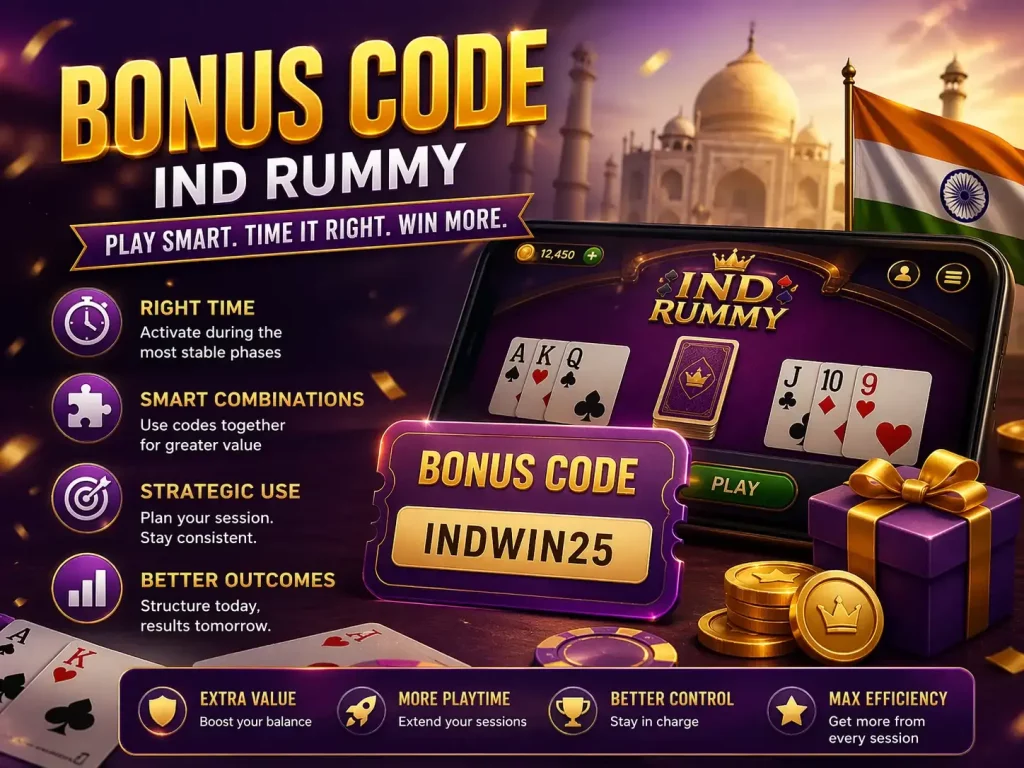
A bonus code can unlock:
- additional balance
- extra play opportunities
- temporary boosts
- session extensions
The real advantage comes from how and when the code is used.
Many players enter a code immediately after sign up without thinking much about timing. This is understandable, but not always optimal. More experienced players prefer to activate bonus codes when they can fully utilize the reward within a structured session.
It is also important to understand that bonus codes are not isolated tools. They interact with:
- session timing
- player discipline
- balance control
- gameplay style
This interaction defines the final outcome.
For example, a player who uses a code during a stable session phase will often extract more value than someone who activates it impulsively. The reward itself is the same — the difference is in execution.
Bonus codes also help bridge different stages of gameplay. They are often used:
- at the beginning to boost starting balance
- during gameplay to extend sessions
- at key moments to increase efficiency
Because of this flexibility, bonus codes are one of the most versatile tools available on the platform.
Types of Bonus Codes in Ind Rummy
Not all bonus codes are the same. Each type serves a different purpose and fits different scenarios.
Each code type plays a role in different stages of gameplay. Understanding this helps players match the right code with the right situation.
Bonus Code Usage Distribution
Different players use bonus codes in different ways. Some rely heavily on them, while others use them occasionally.
This distribution shows that most players focus on early-stage codes, while advanced users leverage VIP codes more effectively.
How Bonus Codes Influence Gameplay
Bonus codes affect gameplay in several ways:
- they extend session duration
- they reduce pressure on balance
- they allow more flexible decisions
- they improve overall efficiency
However, the key factor remains consistency.
Players who treat bonus codes as part of a system tend to perform better than those who use them randomly.
Strategic Use of Bonus Codes
Bonus codes are not just rewards — they are tools for control and efficiency.
Players who:
- understand timing
- apply structure
- stay consistent
get significantly more value from the same codes.
Bonus Code Timing: When Activation Creates Maximum Value
Understanding when to activate a bonus code is just as important as knowing which code to use. Many players focus on availability — they receive a code and immediately apply it. However, timing changes how effectively that code performs within a session.
A well-timed bonus code works as a multiplier of control, not just a multiplier of value. It supports decision-making, stabilizes gameplay rhythm, and aligns with the player’s current state.
To break this down properly, it helps to think in terms of session phases, not just moments.
There are three practical activation windows:
- early session
- mid-session
- late session
Each has its own characteristics, and each affects the outcome differently.
During the early phase, players are still adjusting. Decisions are less refined, pacing is not fully established, and awareness is still forming. Activating a bonus code here can still be useful, especially for building an initial buffer, but it may not reach full efficiency because the session is not yet stable.
The mid-session phase is where most value is extracted. By this point:
- rhythm is consistent
- decisions are more controlled
- focus is higher
Using a bonus code during this stage often produces the most balanced and efficient results. It enhances momentum rather than trying to create it from scratch.
Late-session activation is more situational. If the session remains controlled, a bonus code can still support performance. But if decisions become reactive or rushed, the effectiveness of the code drops. In this phase, discipline matters more than the reward itself.
Timing-Based Bonus Code Efficiency
This table highlights that efficiency is not fixed — it shifts based on timing.
Visualizing Timing Efficiency
To better understand how timing affects performance, we can look at a simple progression model.
The graph shows a clear pattern:
- efficiency rises as the session stabilizes
- peaks during controlled gameplay
- becomes less predictable later
Bonus Codes as a Control Mechanism
Bonus codes are often seen as value boosters, but their deeper function is control.
They help players:
- manage pacing
- smooth transitions between phases
- maintain consistency
- extend effective gameplay
This is especially useful in sessions where decision-making quality matters more than speed.
For example, instead of rushing into gameplay after receiving a code, a structured approach would be:
- assess current session state
- decide the right activation moment
- integrate the reward into the existing flow
This creates continuity instead of fragmentation.
Activation Strategy Comparison
Practical Insight
Bonus codes reach their full potential when they are:
- aligned with session timing
- used during stable phases
- integrated into a broader strategy
They are less effective when:
- activated without planning
- used too early without structure
- applied during unstable moments
The value of a bonus code is not defined at the moment you receive it.
👉 It is defined at the moment you activate it.
And that moment — more than anything else — determines the outcome.
Bonus Code Combinations: How Different Rewards Work Better Together
When players first start using bonus codes, they usually think in isolated terms. A code appears, it is entered, a reward is received, and the session continues. This is the most basic way to use a bonus code, and while it can still provide value, it rarely unlocks the full potential of the reward system.
A more advanced player sees bonus codes differently. Instead of looking at each code as a separate event, they begin to understand how one reward interacts with another. This is where combinations become important.
A bonus code on its own can increase balance or create extra flexibility. But a bonus code that fits into the right session, aligns with the right timing, and supports the right style of play can become much more useful. The result is not just “more value” in a simple sense. It is better rhythm, smoother decision-making, and a more stable session overall.
This is why combination strategy matters. The goal is not to force rewards together at every opportunity. The goal is to understand how different bonus structures can complement each other without disrupting control.
For example, one code may strengthen the start of a session, while another works better during a more stable phase. One may be ideal for extending play, while another is better used when the player wants to create a little more flexibility. These are not identical functions, even if they all fall under the category of “bonus value.”
Another reason combinations matter is that they reduce waste. Many players lose value not because the reward is weak, but because they use it in the wrong order or without enough structure. If a player activates a useful code at the wrong time, then adds another code later in a disorganized way, the total reward may still produce weak results. The value was there, but the structure was missing.
This is why part three should focus on connection rather than just explanation. The page should not only tell the reader that bonus codes exist. It should help them understand how bonus code logic changes when multiple rewards are involved, and how a better structure creates better outcomes.
It is also useful to remember that combinations do not always mean complexity. Many players assume that “advanced use” must mean a very complicated system, but that is not necessarily true. Sometimes the strongest combination is simply the right reward at the right point in the session, followed by the right follow-up decision. Complexity only becomes useful when it supports clarity. If it creates confusion, it stops being an advantage.
A good player does not chase combinations because they look impressive. They use them because they improve control. That is the key shift in mindset.
Why Combination Strategy Matters
There are several reasons why players should think about bonus code combinations instead of only single activations.
The first is session continuity. A reward used in isolation may give a short boost, but a reward used in combination with another structured element can support a more complete session.
The second is efficiency. If one code creates immediate flexibility and another supports a stronger next phase, the combined effect is often smoother than using a single code at random.
The third is clarity. Surprisingly, structured combinations can make a session feel simpler, not harder. When the player already knows what role each reward should play, there is less emotional guessing in the middle of the session.
The fourth is adaptability. Different players have different rhythms. Some prefer tighter control and slower sessions. Others operate better with a little more tempo. Combination logic allows players to fit rewards into their own style instead of forcing the same structure every time.
That is why combination strategy is not about copying a fixed formula. It is about understanding relationships between rewards.
Common Combination Models
At a practical level, most bonus code usage falls into a few recognizable combination models. Some players remain at the simplest level and use only one code at a time with no real structure. Others begin combining rewards in sequence. The most advanced players use a layered approach in which each reward plays a role in a broader session design.
This kind of block changes the page rhythm and keeps the structure from feeling too similar to previous pages. Instead of another standard table, it gives a feature-card progression that feels more product-like and less repetitive.
The key idea here is that value grows when rewards become more connected to the player’s session logic. The reward itself matters, but the relationship between rewards often matters even more.
Choosing the Right Combination for Your Play Style
Not every player should immediately jump to the most advanced structure. The most effective combination is the one that fits the player’s actual decision-making style.
Some players are still building discipline and should keep things simpler. For them, a clean sequential model may be better than a layered one. Others already have stronger control and can benefit from more advanced structures without becoming disorganized.
This is important because a combination only works if the player can actually execute it well. A more complex setup is not automatically superior if it causes hesitation, rushed decisions, or confusion. In many cases, a smaller but cleaner structure outperforms a larger one that is poorly managed.
That is why players should judge combinations by fit, not only by theoretical value.
A player with good pacing may do well with:
- one code for entry stability
- one code for controlled extension
A player with less stable control may do better with:
- one carefully timed code
- a clear stopping point
- no layering beyond that
There is no single universal model. There is only the model that best matches the player’s current level of control.
A Different Visual: Combination Efficiency Ladder
To avoid repeating the same visual language from earlier pages, this section works better with a vertical ladder-style comparison instead of a basic doughnut or standard table. A ladder makes the idea of progression easier to understand.
This kind of visual works well here because it communicates hierarchy, not just category. It reinforces the main point of this section: more structured combinations tend to produce stronger outcomes, provided the player can execute them properly.
How Combinations Influence Session Quality
A strong combination strategy does more than add value. It changes the quality of the entire session.
Without a clear combination plan, a session often feels fragmented. Rewards appear, decisions are made in reaction, and the player is constantly adjusting without structure. This creates friction. Even when rewards are technically valuable, the session may still feel weak because the rewards are not connected to a clear rhythm.
With a combination plan, the session becomes cleaner. Each reward has a role. One supports the beginning, another supports stability, another supports extension. The player is not guessing what to do next. They already understand the purpose of the reward they are using.
That creates several benefits:
- more stable pacing
- stronger decision quality
- less emotional drift
- better overall clarity
This is why combination strategy matters even for players who are not looking for maximum complexity. It improves how the session feels, not just how much value is extracted.
The Most Common Mistake with Multiple Codes
The biggest mistake players make when working with multiple bonus codes is trying to maximize quantity instead of structure.
They see more rewards and assume more activation must be better. But if rewards are stacked without a plan, they often interfere with decision-making instead of helping it. The session becomes noisy. The player loses track of why a reward is being used. At that point, even a strong reward structure can become inefficient.
The better mindset is not:
“how many rewards can I activate?”
It is:
“which reward belongs here, and what should it do for this session?”
That question creates much better decisions.
Combination Strategy and Player Maturity
As players improve, their relationship with combinations changes. Beginners often focus on obvious value. Intermediate players begin to recognize timing. Advanced players start thinking in terms of session architecture.
This progression matters because it shows that combination strategy is not an all-or-nothing skill. It develops over time. A player does not need to master every structure immediately. What matters is moving from random activation toward intentional sequencing.
That movement alone produces a big improvement.
Bonus code combinations work best when each reward has a role. The player does not need to overcomplicate the session, but they do need to connect rewards to timing, structure, and purpose.
The biggest upgrade is not receiving more codes.
👉 It is learning how to make different codes work together without losing control.
Long-Term Bonus Code Optimization: Building Consistency Over Time
At the final stage, bonus codes should no longer feel like isolated opportunities or even simple combinations. Instead, they become part of a repeatable system that supports stable and predictable gameplay.
The difference here is subtle but important.
In earlier stages:
- players react to available codes
- timing is improved but still flexible
- combinations are used when convenient
At a more advanced level:
- activation becomes intentional
- structure is consistent across sessions
- decisions are made before the session begins
This is what turns bonus codes into a long-term advantage rather than a short-term boost.
It is also where simplicity becomes powerful again.
Many players assume that long-term optimization requires constant complexity. In reality, the opposite is often true. The most effective systems are built on clear rules that are easy to repeat.
For example:
- when to activate a code
- how it fits into session phases
- what role it should play
- when not to use it
When these rules become consistent, the player no longer needs to rethink every decision from scratch. The system does the work.
Core Elements of a Long-Term Bonus Code System
A stable system is built around a few key elements. These are not complicated individually, but together they create consistency.
Each of these elements reinforces the others. Consistency without clarity leads to repetition without improvement. Clarity without timing leads to missed opportunities. Timing without discipline leads to inconsistency.
When all elements are aligned, the system becomes reliable.
The Role of Simplicity in Optimization
A key idea that often gets overlooked is that simplicity improves performance.
Players who constantly change their approach tend to lose efficiency, even if each individual idea seems good. On the other hand, players who refine a small number of clear patterns often perform better over time.
This is because:
- decisions become faster
- mistakes become easier to detect
- adjustments become more precise
Bonus codes work best when they are part of this simplified structure.
Instead of asking:
“What is the best possible move right now?”
The player begins to ask:
“Which part of my system applies here?”
This shift reduces noise and increases clarity.
Long-Term Performance Comparison
To visualize how structured use evolves over time, it helps to compare different approaches across multiple sessions.
This comparison highlights an important point:
- unstructured usage may fluctuate
- structured usage tends to improve over time
The advantage is not immediate in every single session, but it becomes clear across multiple sessions.
System-Based Decision Flow
Instead of reacting to every new bonus code, a structured approach follows a predictable flow.
This flow removes randomness and replaces it with structure.
Final Perspective on Bonus Codes
Bonus codes are often introduced as simple rewards, but their real value becomes clear only when they are used consistently and intentionally.
They are not just about:
- extra balance
- temporary boosts
- short-term advantages
They are about:
- control
- timing
- structure
- clarity
A player does not need to use every available code. They need to use the right code in the right way.
Over time, this approach leads to:
- more stable sessions
- clearer decisions
- better overall performance
The strongest players are not the ones who activate the most bonus codes.
👉 They are the ones who understand how each code fits into a structured system.
That understanding — more than any individual reward — is what creates consistent results.






Comments